Why EVERY Incident Matters❓
Many workplace accidents are not isolated events. In fact, serious incidents are often preceded by warning signs such as near misses, unsafe acts, and unreported hazards. Unfortunately, these warning signs are frequently overlooked or poorly documented, allowing risks to remain unresolved until a more severe accident occurs.
According to safety management principles, every reported incident provides valuable information that organizations can use to improve workplace safety. However, capturing, investigating, and tracking incidents effectively can be challenging when relying on paper forms, spreadsheets, or email communications.
This is where incident reporting software plays a critical role.
By digitizing the incident management process, organizations can identify trends, address root causes, and implement corrective actions before accidents happen again.
What is Incident Reporting Software?
Incident reporting software is a digital solution that enables organizations to record, investigate, and manage workplace incidents through a centralized platform.
The system typically allows employees and supervisors to:
- Report incidents and near misses
- Record injuries and property damage
- Capture photos and supporting evidence
- Conduct investigations
- Perform root cause analysis
- Assign corrective actions
- Monitor action completion
- Generate safety reports and analytic
Instead of managing multiple documents and spreadsheets, all incident-related information is stored in a single system for better visibility and control.
The Problem with Traditional Incident Reporting
Many organizations still manage incidents using manual processes.
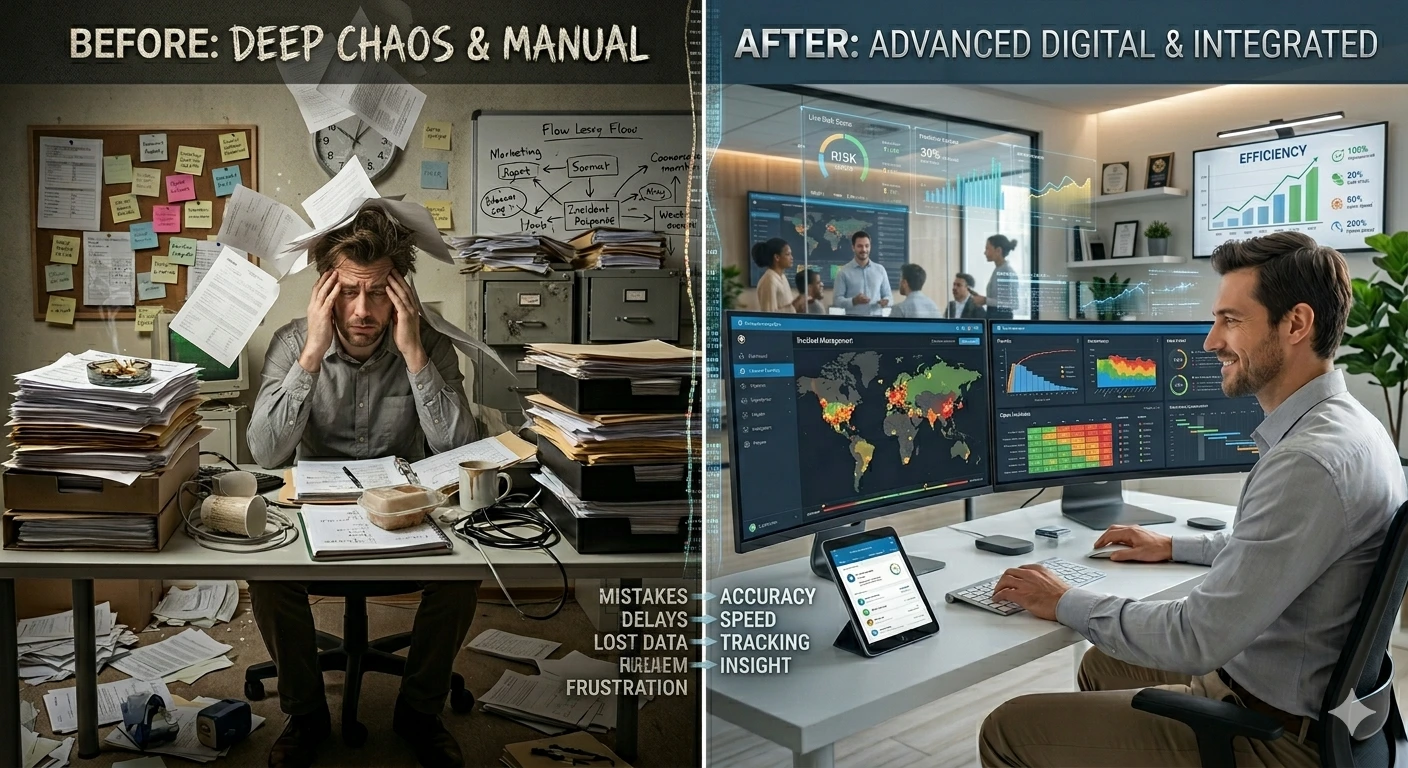
Common challenges include 👇
⚠️Delayed Reporting
Employees may wait hours or even days before submitting reports, causing critical information to be lost or forgotten.
⚠️Incomplete Information
Paper forms often lack important details such as photographs, witness statements, or investigation findings.
⚠️Poor Follow-Up
Corrective actions may be assigned verbally and forgotten, leading to unresolved hazards.
⚠️Limited Visibility
Management teams struggle to identify recurring trends because incident data is scattered across multiple files and departments.
As a result, organizations may repeatedly experience similar incidents without understanding the underlying causes.
How Incident Reporting Software Prevents Workplace Accidents
1. Encourages Faster Incident Reporting
One of the biggest advantages of digital incident reporting is speed.
Employees can immediately report:
- Unsafe conditions
- Near misses
- Property damage
- Injuries
- Environmental incidents
The sooner an incident is reported, the sooner corrective actions can be implemented. Real-time reporting helps organizations address hazards before they escalate into serious accidents.
2. Captures Near Misses Before They Become Accidents
Many organizations focus only on accidents that cause injuries.
However, near misses often provide the greatest opportunity for prevention.
For example:
- A forklift narrowly misses a pedestrian in a warehouse.
- No injury occurs, so the incident is ignored.
- Weeks later, a similar event results in a serious injury.
A structured reporting system ensures near misses are documented, investigated, and acted upon before a more severe incident occurs.
3. Enables Effective Root Cause Analysis
Treating symptoms DOES NOT solve safety problems.
To prevent recurrence, organizations must understand why an incident happened in the first place.
Incident reporting software supports structured investigations using techniques such as:
- 5 Whys Analysis
- Fishbone Diagram Analysis
- Root Cause Investigation
- Corrective and Preventive Action (CAPA)
Rather than simply recording what happened, organizations can identify the underlying causes that contributed to the incident.
Examples include:
- Inadequate training
- Poor procedures
- Equipment failure
- Lack of supervision
- Unsafe workplace conditions
Addressing root causes significantly reduces the likelihood of repeated incidents.
4. Improves Corrective Action Tracking
One of the most common reasons incidents recur is that corrective actions are never completed.
A digital system ensures that:
- Actions are assigned to responsible personnel
- Due dates are established
- Automated reminders are sent
- Completion status is monitored
- Management can verify effectiveness
This accountability ensures that identified hazards are properly addressed.
5. Identifies Trends and High-Risk Areas
Individual incidents may not reveal much on their own.
However, when incident data is analyzed collectively, valuable insights emerge.
Organizations can identify:
- Departments with frequent incidents
- High-risk activities
- Common injury types
- Recurring hazards
- Seasonal safety trends
This information helps safety teams focus resources where they are needed most.
Instead of reacting to incidents, organizations can proactively manage risks.
6. Strengthens Safety Culture
A strong safety culture depends on employee participation.
When workers see that reported issues are investigated and resolved, they become more willing to report future concerns.
This creates a positive cycle:
Report → Investigate → Correct → Improve
Over time, employees become active contributors to workplace safety rather than passive observers.
Industries That Benefit Most from Incident Reporting Software
Incident reporting software provides value across many industries, including:

Manufacturing
Track machinery incidents, unsafe conditions, and production-related hazards.

Construction
Manage site incidents, near misses, and contractor safety reporting.

Logistics and Warehousing
Monitor vehicle incidents, loading operations, and pedestrian safety.

Oil and Gas
Support high-risk operations with detailed incident investigation workflows.

Chemical and Pharmaceutical
Track chemical spills, exposure incidents, and environmental events.
Regardless of industry, effective incident management is essential for reducing risk and maintaining compliance.
Beyond Compliance: Creating a Safer Workplace
Many organizations implement incident reporting systems simply to satisfy compliance requirements.
However, the true value lies in PREVENTION.
A well-designed incident reporting process helps organizations:
- Reduce workplace accidents
- Improve employee safety
- Minimize operational disruptions
- Lower investigation costs
- Enhance regulatory compliance
- Strengthen organizational accountability
The result is not only a safer workplace but also a more efficient and resilient business.
How KeywayEHS Simplifies Incident Management
Managing incidents manually can be time-consuming and ineffective, especially as organizations grow.
KeywayEHS Incident Management Module helps organizations digitize the entire incident lifecycle, from initial reporting to investigation and corrective action tracking.
With KeywayEHS, businesses can:
- Report incidents and near misses digitally
- Capture photos and supporting evidence
- Conduct structured investigations
- Perform root cause analysis
- Assign and track corrective actions
- Monitor trends through real-time dashboards
- Maintain centralized records for audits and compliance
By transforming incident management into a proactive safety process, organizations can reduce recurring incidents and build a stronger safety culture.
⁉️Frequently Asked Questions (FAQ)
Incident reporting software is a digital platform used to record, investigate, track, and analyze workplace incidents, near misses, injuries, and hazards.
The software enables faster reporting, root cause analysis, corrective action tracking, and trend monitoring, helping organizations prevent similar incidents from recurring.
Near misses provide early warning signs of potential hazards. Investigating near misses allows organizations to implement corrective actions before injuries occur.
A comprehensive incident report should include the date, time, location, individuals involved, description of the incident, photographs, witness statements, and investigation findings.
Yes. Incident reporting software helps maintain accurate records, track investigations, and provide documentation required for compliance and audits.
Industries such as manufacturing, construction, logistics, oil and gas, chemical processing, and warehousing can significantly improve safety performance through digital incident management.
KeywayEHS provides a centralized platform for incident reporting, investigation, root cause analysis, corrective action tracking, and safety performance monitoring, helping organizations improve workplace safety and compliance.
Workplace accidents rarely happen without warning signs ⚠️. A robust incident reporting system helps organizations identify risks early, take corrective action, and prevent incidents from happening again.
Ready to move beyond spreadsheets and paper forms?
Discover how KeywayEHS can help your organization build a safer, smarter workplace!